
Why public-private partnership must go ‘beyond bricks and mortar’ to get the NHS back on track
24/11/2025
Why public-private partnership must go ‘beyond bricks and mortar’ to get the NHS back on track
The Government’s Ten-Year Health Plan presents a welcome, ambitious reform agenda, with the three ‘shifts’ it proposes shared across the NHS and independent healthcare sector.
But its successful delivery will hinge on effective capital investment.
As of today, the NHS capital regime remains ‘broken’. Lord Darzi’s independent investigation highlighted a £37 billion shortfall in capital spending in the NHS since 2010, with “underinvestment” in capital, compounded by a “dysfunctional” capital regime.
There has been growing consensus that public-private partnerships are part of the solution to NHS’s capital challenge, given that public investment will be constrained in the coming years and the NHS already has a maintenance backlog, now exceeding £16bn.
Last week, the IHPN and Future Health published a new report, Building Better Health which explores how to fix these challenges.
Its core argument is simple: public-private partnership between the NHS and independent healthcare providers can go beyond ‘bricks and mortar’, enabling both private investment in improved premises, as well as unlocking the capability and expertise to deliver services on an ongoing basis.
Building Better Health profiles how the independent sector is already successfully partnering across a wide range of services, benefitting NHS patients. It shows how:
- InHealth’s £32m investment in new Community Diagnostic Centres across the Southwest will enable millions of diagnostic tests over the life of the contract.
- Ramsay Health Care UK’s Glendon Wood Hospital is treating thousands of NHS patients across key specialties—an investment that also boosts the local workforce and economy.
- HCA’s partnership with University Hospitals Birmingham is providing 72 additional beds for NHS patients, supporting efforts to reduce waiting lists without requiring NHS capital to construct the facility.
- GenesisCare UK’s new cancer centre in Guildford is expanding access to cutting-edge diagnostics, radiotherapy and clinical trials.
- Agito Medical’s relocatable catheter lab has enabled Epsom and St Helier to enhance its cardiac pathways.
- OneMedicalGroup’s development of the Aspull Health and Wellbeing Centre demonstrates the way independent sector providers can help to modernise primary care estates with community-centred design and long-term flexibility.
These should not be regarded as isolated case studies; they are evidence of what is possible when these partnerships are based on mutual understanding, effective alignment of what each party brings to the table and there is effective alignment with local and national priorities.
Today though, these partnerships are too often held back. Not by a lack of appetite, but by obstacles that are all too familiar with the current approach to capital: slow approvals; unclear accounting rules; inconsistent decision-making; and a lack of long-term planning.
These all hamper the ability to make full use of private capital – and to maximise the role the independent sector can play.
So what needs to be done to fix this?
- First, HM Treasury should update Green Book guidance to give NHS leaders confidence in the off-balance sheet mechanisms available to support capital partnerships.
- Second, we recommend establishing a National Strategic Council for Healthcare Infrastructure. Other parts of the healthcare ecosystem, such as life sciences, benefit from mature, structured partnerships between government, the NHS and industry. A similar forum for capital and infrastructure would enable consistent dialogue, shared problem-solving and alignment on major programmes.
- Third, the Government’s pledge to deliver neighbourhood health centres can only be realised through a dedicated programme of investment. A Neighbourhood Health Capital Fund could attract private investment, while being supplemented by public funding where appropriate. Updating the Premises Cost Directions would further signal that innovation in the primary care estate is both expected and supported.
- Fourth, the NHS needs clearer accountability for capital delivery. Introducing a new performance indicator within the NHS Oversight Framework would help ensure long-awaited reforms to streamline approvals translate into greater pace on the ground.
- Finally, NHS England should publish clear guidelines on the role of public-private partnerships for elective recovery. There is already strong evidence that capital and service partnerships can expand capacity and enhance productivity.
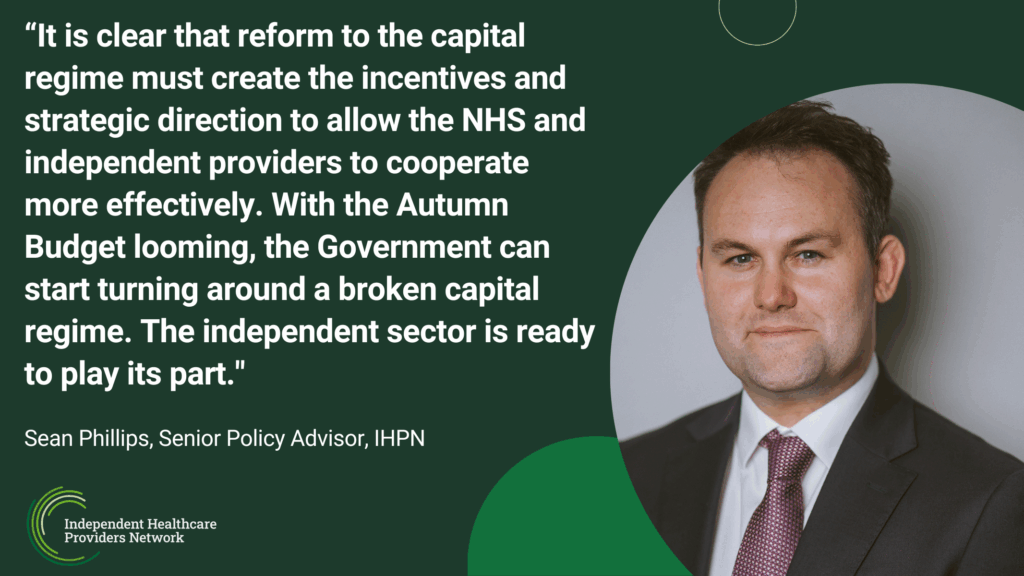
It is clear that reform to the capital regime must create the incentives and strategic direction to allow the NHS and independent providers to cooperate more effectively.
With the Autumn Budget looming, the Government can start turning around a broken capital regime. The independent sector is ready to play its part.