What will the 2027/27 Standard Contract and Payment Scheme mean for independent healthcare providers
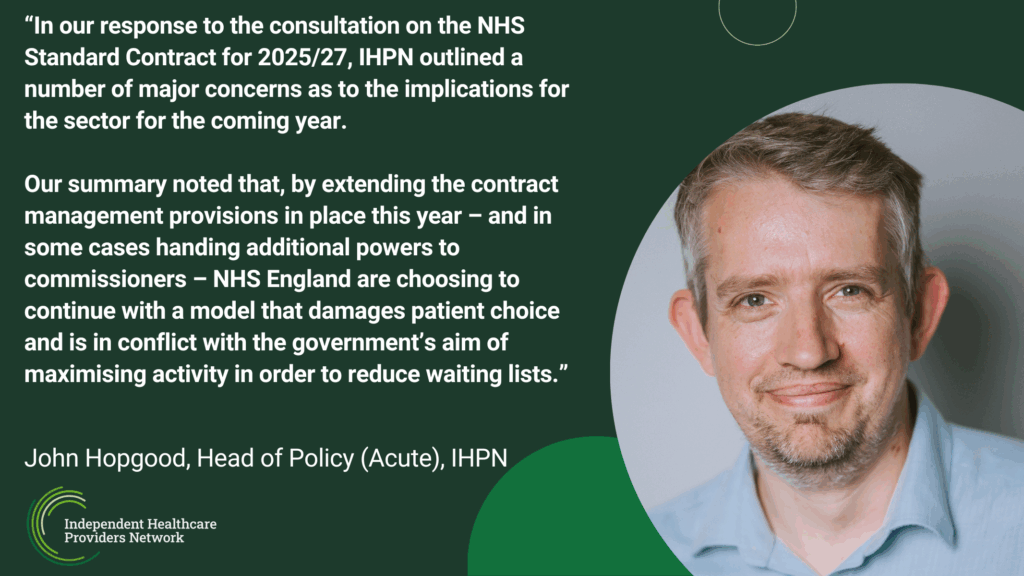
IHPN’s Head of Policy (Acute) John Hopgood looks at what the proposed 2026/27 NHS Standard Contract and Payment Scheme will mean for independent providers
In our response to the consultation on the NHS Standard Contract for 2025/27, IHPN outlined a number of major concerns as to the implications for the sector for the coming year. Our summary noted that, by extending the contract management provisions in place this year – and in some cases handing additional powers to commissioners – NHS England are choosing to continue with a model that damages patient choice and is in conflict with the government’s aim of maximising activity in order to reduce waiting lists.
But what makes us say this?
Largely, these are the same concerns we raised last year, concerns that IHPN members around the country have seen play out in practice.
The Indicative Activity Plan (IAP) setting process is a prime example. We raised concerns that these would be used as de facto payment limits – they have been. We suggested to NHS England that commissioners would not set IAPs based on a realistic model for delivering care across their system, and instead concentrate first on ensuring trusts have the budgets they need. We have seen this across the country. Referrals to the sector have far outstripped ‘planned’ activity, while many trusts have struggled to meet their activity targets.
We have also heard reports that, in some areas, commissioners have reverted to block contract arrangements for trusts to ensure budgets are balanced – regardless of the implications for activity this may have. As we stated in our response to the Payment Scheme consultation, activity-based payments are essential not only to ensure a level-playing field, but, at a fundamental level, to ensure that the NHS delivers value for money. Block contracting removes all incentives to deliver activity more efficiently.
We’re particularly worried that the proposals for 2026/27 will remove the contract escalation process that was introduced last April. NHS England argue that feedback was that the process was unhelpful. We agree – but our conclusion is different.
Even of the extremely narrow, very technical grounds for escalation, around 50% of all escalations have been upheld. That demonstrates exactly what we feared – commissioners are not even following tick-box exercises properly. How, then, can NHS England, the government and the public be reassured that they are planning the right levels of activity to meet their local population’s needs? Essentially, the escalation process was unfit for purpose.
Rather than remove the escalation process, we argue that it should be widened. The grounds for escalation should allow for a substantive review of the commissioner’s adherence to commissioning guidelines and patient choice regulations in the setting of the IAP or AMP. The scope for escalation should include a full assessment of whether that IAP or AMP is compatible with the national planning priorities and system-level activity targets. All escalations should include a review of system-level activity plans, and be based on historic as well as projected activity levels, patient referral rates and activity share – including scope for new entrants to the provider market.
Why is this important? Because enforceable IAPs have a direct impact on patient choice. If a commissioner can determine precisely how much activity each provider can deliver, then it is also deciding which patients are able to access a meaningful choice of treatment. Patients can be denied the right to be seen more quickly, by a more convenient provider, or by a provider with better outcomes based entirely on how commissioners have allocated their funding pot.
That is fundamentally in opposition to the core principle of patient choice – money follows the patient. That’s why IHPN have pushed back strongly against the proposal to extent this contracting mechanism, and it’s why we’re continuing to raise this with NHS England and government to find a more sustainable solution that allows the efficient delivery of patient care, while protecting patient choice.