
Patient Safety Incident Response Framework three years on - what have we learned?
13/03/2026
IHPN’s Head of Patient Safety and Quality Governance Linda Jones looks at ther past three years since the introduction of the Patient Safety Incident Response Framework (PSIRF), and discusses how the sector has embraced PSIRF, and what the learnings have been in the three years since it was implemented.
As IHPN members (and indeed all healthcare providers) will be aware, there has been significant change in the patient safety landscape over the past few years as policy and best practice in this area evolves.
One such example of this is the introduction in 2023 of the Patient Safety Incident Response Framework (PSIRF). Replacing the 2015 Serious Incident Framework, PSIRF is designed to look at patient safety incidents in a different way – moving away from investigation-heavy approaches which focus on “fault”, and towards a learning-based, system-level insight of incidents with the aim to better understand the complex conditions shaping care and safety outcomes.
PSIRF is now mandatory for NHS bodies and providers operating under the NHS Standard Contract and here at IHPN we have done a significant amount of work with our members to support them in transitioning to this new way of looking at patient safety incidents. Three years on from its initial implementation what have we learned?
Over the last few months, I’ve spoken to Patient Safety Specialists, clinicians, and governance leads across a range of independent sector providers about how they have transitioned to PSIRF and what impact it has had on their organisation. You can read the full report here on our website.
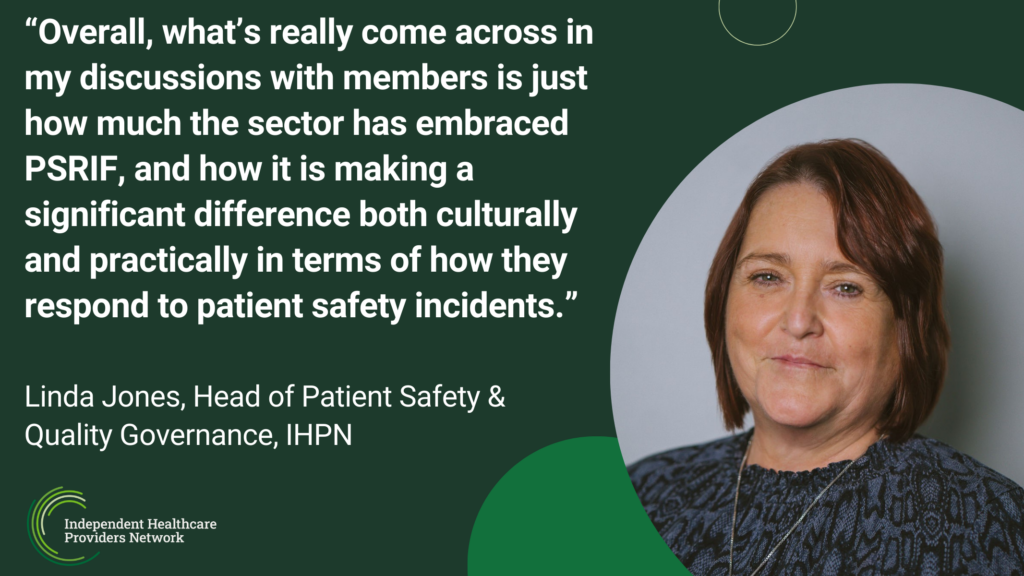
Overall, what’s really come across in my discussions with members is just how much the sector has embraced PSRIF, and how it is making a significant difference both culturally and practically in terms of how they respond to patient safety incidents.
One of the key successes in terms of implementing PSIRF has been a tangible improvement in the capability of providers to undertake “systems-based” learning from patient safety incidents. Significant training has taken place across the sector in PSIRF methodologies, human factors models such as SEIPS (which analyses how system components e.g. people, tools, tasks, environment, processes interact and influence outcomes) and reflective learning. All of which members tell us has led to more consistent investigations and richer system insight.
Linked to this, PSIRF has improved integration with wider organisational governance systems, aligning incident learning with quality improvement, Freedom to Speak Up, and risk management, and patient feedback. As a result, providers tell us they are increasingly able to better identify risks and recurring issues, prioritise improvement activity more effectively, and implement changes that strengthen safety across services rather than addressing incidents in isolation.
Patient and family involvement – a core part of the PSIRF approach – has also strengthened in the last three years. Providers describe more transparent communication and a greater emphasis on compassion and partnership. In particular, shifting towards more empathetic, inclusive engagement – with families often invited to contribute directly to investigations – has dramatically improved the quality of learning and insight into patient safety incidents.
While there have been clear benefits for independent healthcare providers – and most critically, for patients – in implementing PSIRF, our conversations with members show that for smaller providers particularly and those with low incident volumes, there remain key challenges around successfully embedding PSIRF in their organisations.
A core part of this is the real need for more accessible, scalable training pathways that reflect the diversity of provider size, service type, and incident volumes. Indeed, providers have noted a limited availability of trainers with a strong understanding of the independent sector, which presents a further barrier to effective implementation. Likewise smaller organisations also report challenges maintaining a sufficient pool of trained investigators and learning response leads, given their more limited workforce capacity and lower frequency of complex incidents. Tailored training programmes for smaller workforces and access to National Training programmes would be beneficial to providers and IHPN have been working with NHS England and HSSIB to help try and overcome these issues.
Within the sector, there is also strong appetite for shared tools, templates, and standardised resources to support proportionality decisions, documentation, evidence gathering, and communication with families. Many providers note that developing these tools independently can be time-consuming and duplicative, and that additional sector-wide resources provided from NHS England would enable greater alignment, reduce variation, and help smaller organisations integrate PSIRF more efficiently.
Looking back at the last three years since its introduction, talking to members it’s clear that PSIRF has been embedded as a core element of patient safety governance for organisations in the independent healthcare sector, with all relevant members working towards full implementation.
And here at IHPN, we are committed to playing our role in ensuring members have the tools they need to fully implement PSIRF. This includes through working with our partners in NHS England, HSSIB and other healthcare regulators to ensure equitable access to training and particularly help support smaller providers bolster their investigative expertise, as well as continuing our work to bring providers together through Communities of Practice and Reference Groups to sharing practical tools and examples of good practice. What is most critical however is the real drive and sense of momentum within the sector to embed PSIRF in their organisations – further demonstrating the sector’s commitment to continuously improving safety and quality and ensuring patients can access the best possible care.