
Could workplace healthcare schemes become part of the answer to getting Britain working again?
28/07/2026
Earlier this month, Practice Plus Group announced they have become a preferred healthcare partner for the National Police Healthcare Scheme, joining Nuffield Health, Spire and HMT. The scheme, is one of many similar workplace schemes which play in important role in helping people stay healthy, return to work more quickly and reduce pressure on the NHS.
As the new Government looks for ways to tackle economic inactivity, this feels like an area set to become even more significant in supporting workforce wellbeing.
Sir Charlie Mayfield’s Keep Britain Working review argues that employers need to play a much bigger role in supporting the health of their workforce. From workplace health checks and earlier intervention to better occupational health and return-to-work support, the report sets out a vision where keeping people healthy at work becomes a shared responsibility between employers, employees and the health service.
That matters because the challenge is enormous. Around 2.8 million people are now economically inactive due to long-term sickness, costing the economy billions of pounds each year through lost productivity while placing increasing pressure on public finances and the welfare system.
Not just a perk for the boardroom
When people think about private healthcare, they often picture executive benefits at large multinational companies. But workplace healthcare has a much broader history.
The National Police Healthcare Scheme is a good example. A long-established, not-for-profit scheme, it gives serving police officers, staff and their families access to private healthcare, providing faster diagnosis and treatment when they need it.
Nor is policing alone.
Transport for London operates a voluntary healthcare scheme for eligible employees. Benenden Health, meanwhile, has its origins in the early 1900s, when it was established as a sanatorium for postal workers and civil servants suffering from tuberculosis. More than a century later, it continues to provide healthcare and wellbeing services to individuals, families and employers through a mutual, not-for-profit model.
Even organisations that are often perceived as sceptical about the role of the independent sector recognise the value of supporting employee health. The Guardian offers private healthcare as part of its employee benefits package.
These examples demonstrate that workplace healthcare is not solely the preserve of wealthy corporations or highly paid executives. Different models have evolved to support a wide range of workers, from police officers and transport staff to journalists and civil. Many independent healthcare providers also invest in the health and wellbeing of their own workforce, recognising that supporting staff to stay healthy and access timely treatment is not only good for employees but also helps retain skilled staff and reduce sickness absence.
An investment, not simply an employee benefit
The conversation is also changing.
For employers facing high levels of sickness absence, the value of healthcare schemes is not simply that they offer an attractive staff benefit. Faster access to diagnostics, physiotherapy, surgery or mental health support can mean employees recover sooner, spend less time away from work and return more quickly to productive employment. Delays in treatment can also have a knock-on effect on people’s wider health and wellbeing. Living with pain, reduced mobility or ongoing uncertainty about a health condition can increase the risk of anxiety, depression and social isolation, making recovery and a return to work even more difficult.
That is entirely consistent with the direction set out in the Keep Britain Working review, which calls for earlier intervention, improved workplace health provision and stronger collaboration between employers and healthcare providers.
As employers look for new ways to support workforce health, insurance-backed healthcare already appears to be gaining momentum. IHPN’s Going Private 2025 report found that almost six in ten people who had used private healthcare funded it through private medical insurance, either via their employer or a personal policy compared with just under half in 2023. Growth was evident across all age groups, including among younger adults, suggesting workplace healthcare could play an increasingly important role in helping people access timely treatment and return to work more quickly.
The market appears to be responding too. According to the Private Healthcare Information Network (PHIN), demand for privately funded healthcare continues to grow, Q1 2025 was the highest quarter ever for admissions (174,920) paid for with private medical insurance with private medical insurance-funded admissions increasing alongside self-pay activity as employers and individuals seek quicker access to treatment.
Could we see more workplace healthcare schemes?
As employers become increasingly focused on workforce health, retention and productivity, it would not be surprising to see more organisations explore collective healthcare schemes.
That does not necessarily mean expensive private medical insurance for everyone. Mutual schemes, occupational health partnerships and employer-supported access to independent healthcare can all play a role in helping people receive timely diagnosis and treatment while continuing to rely on the NHS for the majority of their care.
There is growing recognition that improving the nation’s health is not solely the responsibility of the NHS. Employers, healthcare providers and government all have a role to play.
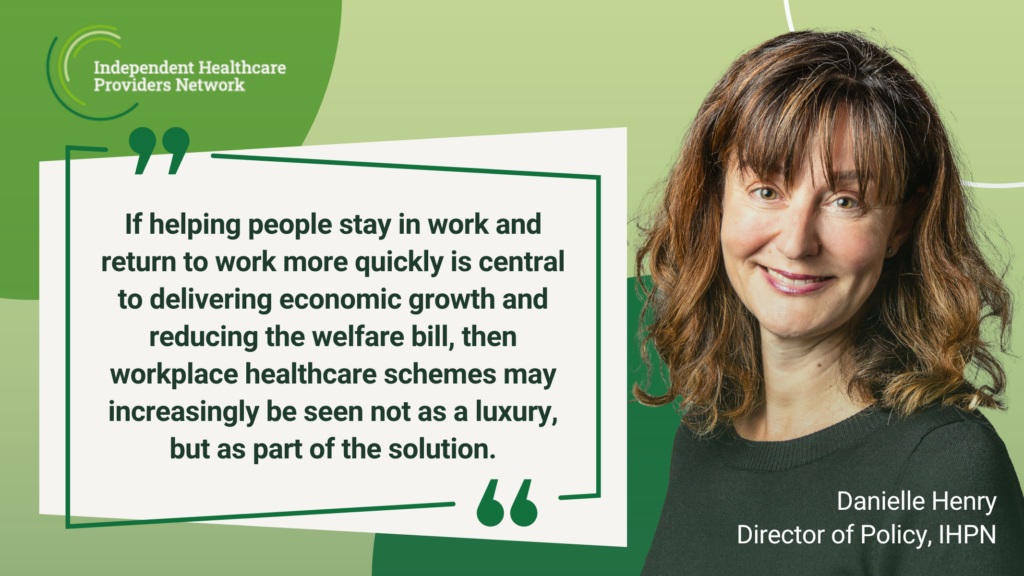
If helping people stay in work and return to work more quickly is central to delivering economic growth and reducing the welfare bill, then workplace healthcare schemes may increasingly be seen not as a luxury, but as part of the solution.
IHPN is proud to be playing its part in this agenda. Alongside a number of our members, we are one of more than 150 organisations taking part in the Government’s Keep Britain Working Vanguard programme, helping to test new approaches to supporting healthier workforces and reducing economic inactivity.
Independent healthcare providers already play an important role in keeping people healthy, diagnosing conditions earlier and helping people return to work more quickly. As the Vanguard programme develops, we hope to see even greater collaboration between employers, the NHS and the independent sector to ensure that more people can access the care they need, when they need it, so they can stay in or get back to work.