
AI in healthcare: opportunity, realism and what our members are telling us
31/03/2026
IHPN’s Director of Policy Danielle Henry looks at how AI is increasingly being applied across the independent healthcare sector by our members to improve efficiency, diagnostics, and patient care.
Artificial intelligence is no longer a future concept in healthcare — it is already shaping how services are delivered, how clinicians make decisions, and how organisations manage growing demand. As our infographic shows, adoption is accelerating quickly across healthcare.
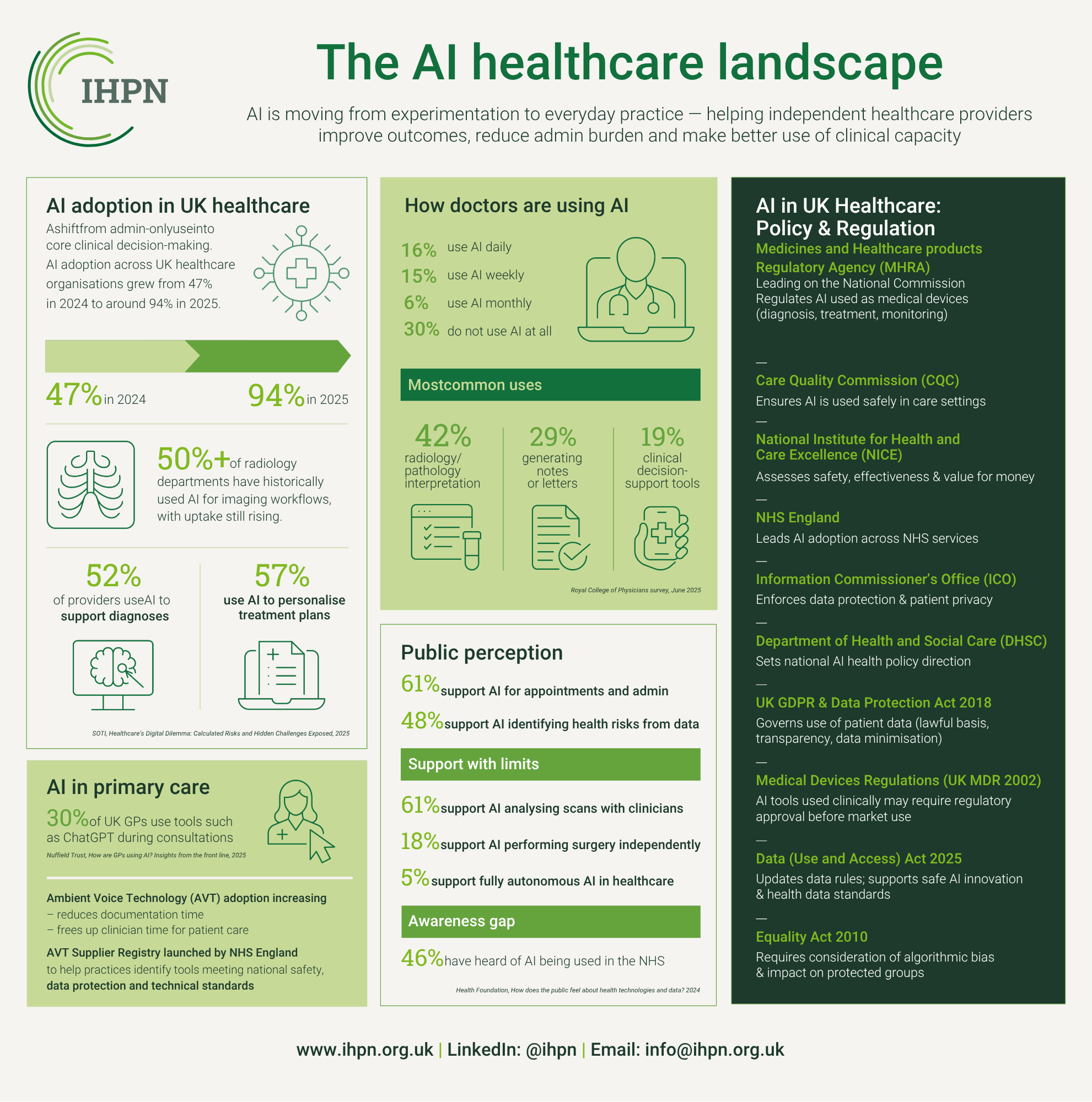
But alongside that growth, there is a clear message from IHPN members: while the opportunity is significant, the path to safe, effective and scalable adoption is far from straightforward.
A sector moving from exploration to application
Across the independent sector, AI adoption is at varying stages of maturity. Some organisations are still in early exploration, while others have already embedded it into their service delivery models. What is clear, however, is a shared direction of travel.
Members are increasingly focused on using AI to:
- Improve operational efficiency and reduce administrative burden
- Support clinical decision-making and diagnostics
- Optimise workforce capacity
- Meet rising patient expectations for more personalised, digital care
This is not about adopting technology for its own sake. The strongest examples we are seeing are grounded in solving real, practical challenges.
At Ramsay Health Care, for example, AI is being used to support clinical documentation, automate administrative processes and ease pressure on workforce-constrained roles such as clinical coding. The approach is deliberately pragmatic, embedding AI into existing systems and focusing on incremental, measurable improvements.
Similarly, Optegra is using AI to support diagnostic decision-making in high-volume eye care pathways, helping clinicians triage patients more effectively and maintain consistency across sites.
And at InHealth, AI is already embedded within diagnostic equipment, reducing scan times and increasing throughput, a clear example of how technology can directly improve access for patients.
Across these examples, a consistent theme emerges: AI is supporting clinicians, not replacing them. The “human in the loop” model remains central.
The challenges: what members are telling us
While progress is encouraging, our engagement with members highlights a number of shared challenges that need to be addressed if AI is to scale safely and effectively.
Data privacy and trust remain fundamental. The use of health data means organisations must navigate strict requirements under UK data protection law. But beyond compliance, there is a broader issue of public confidence. Patients need to understand how their data is used and feel reassured that it is being handled responsibly.
Bias and fairness are also key concerns. AI systems are only as good as the data they are trained on. If that data is not representative, there is a risk of reinforcing existing health inequalities. Members are clear that this is not just a technical issue, but an ethical one.
Regulation and safety present another challenge. AI tools used in clinical settings must be properly validated, approved and monitored over time. However, the current regulatory landscape can feel complex and fragmented, with multiple bodies involved across safety, quality, data and implementation.
Integration with existing systems is a practical but significant barrier. Many NHS and healthcare IT systems are not designed to support modern AI tools, making implementation slower and more resource-intensive than it should be.
Alongside these structural challenges, members also highlighted more operational constraints, from the cost of investment and competing priorities, to skills gaps and limited access to specialist expertise.
A pivotal moment for regulation
These challenges come at a time when the UK is actively shaping its approach to AI in healthcare regulation.
Medicines and Healthcare products Regulatory Agency launched a call for input on the future regulation of AI in December, supported by a new Commission tasked with shaping a framework that works for the health system as a whole. This is a positive and important step, recognising the need to balance innovation with patient safety, while ensuring regulation keeps pace with rapid technological change.
It is particularly encouraging that the independent sector is represented on the Commission, helping to ensure that the perspectives of providers delivering significant volumes of NHS care are reflected in its work.
As AI continues to evolve, there is a clear need for a regulatory approach that ensures patient safety and public trust, provides clarity and consistency for providers, and enables innovation to move more quickly from pilot to practice. For independent providers, this clarity will be critical. Many members have highlighted the complexity of navigating multiple regulatory and governance requirements, and the Commission presents a real opportunity to develop a more coherent, joined-up approach that supports safe adoption across the whole system.
What needs to happen next
Based on what we are hearing from members, there are several areas where action will be important.
First, there is a need for a more joined-up regulatory framework. Reducing duplication and improving alignment between organisations such as MHRA, CQC, NICE, NHS England and the ICO would make it easier for providers to adopt AI safely and consistently.
Second, approval pathways need to be proportionate and timely. Expanding regulatory sandboxes and enabling faster routes for lower-risk tools would help organisations test and deploy innovation more effectively.
Third, investment in digital and data infrastructure is essential. AI can only deliver its full potential if it is underpinned by high-quality, interoperable data and modern IT systems across both NHS and independent providers.
Fourth, there is a clear need to build workforce capability. Clinicians, coders and operational teams all need the skills and confidence to use AI effectively, supported by practical guidance and training.
Finally, public trust must remain at the centre. Clear expectations around transparency, fairness and how AI is used in patient care will be critical to maintaining confidence as adoption grows.
A pragmatic path forward
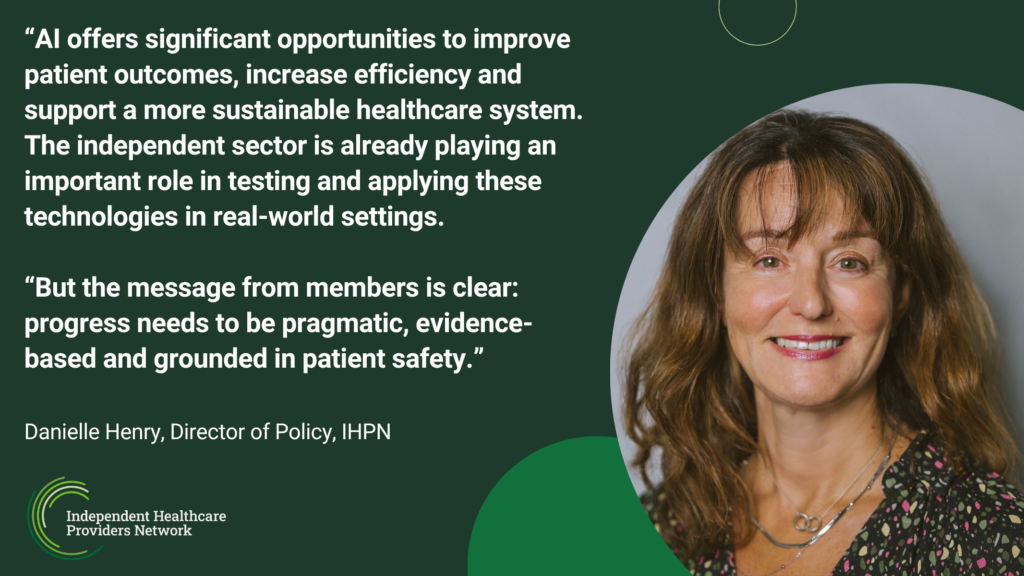
AI offers significant opportunities to improve patient outcomes, increase efficiency and support a more sustainable healthcare system. The independent sector is already playing an important role in testing and applying these technologies in real-world settings.
But the message from members is clear: progress needs to be pragmatic, evidence-based and grounded in patient safety.
AI is not a silver bullet. It is a tool, one that, used well, can support clinicians, improve access and enhance care.
The task now is to create the right conditions for that to happen at scale, across the whole health system.