

What do the Scotland and Wales elections mean for independent healthcare?
05/05/2026
IHPN’s Director of Communications, Cara McDonagh, takes a closer look at how this week’s elections in Wales and Scotland reinforce three overarching dynamics: health remains the dominant political issue; the role of non-NHS capacity is increasingly relevant but politically sensitive; and the policy environment is becoming more fragmented and variable across parties and nations.
Wales
In Wales, the potential end of Labour’s long-standing dominance points to a more plural and competitive political landscape. Plaid Cymru is likely to be the winner and will be looking to form a government with another party, possibly the Greens who are also expected to do well. In terms of the independent sector, Plaid Cymru are publicly cautious, however there is an underlying pragmatism about the scale of NHS pressures and the need to expand capacity. This does however need to be framed through a clear expectation that provision is “home-grown”, rooted in Wales, supporting the Welsh workforce and economy. Their manifesto includes a pledge a stated ambition to reduce reliance on cross-border care over time.
Across the parties, there is a consistent focus on reducing waiting times, expanding diagnostics and increasing system capacity, albeit framed differently. Reform UK and the Conservatives place greater emphasis on system reform, central control and patient choice, while Labour’s position remains more cautious, focused on NHS-led delivery but shaped by ongoing performance challenges.
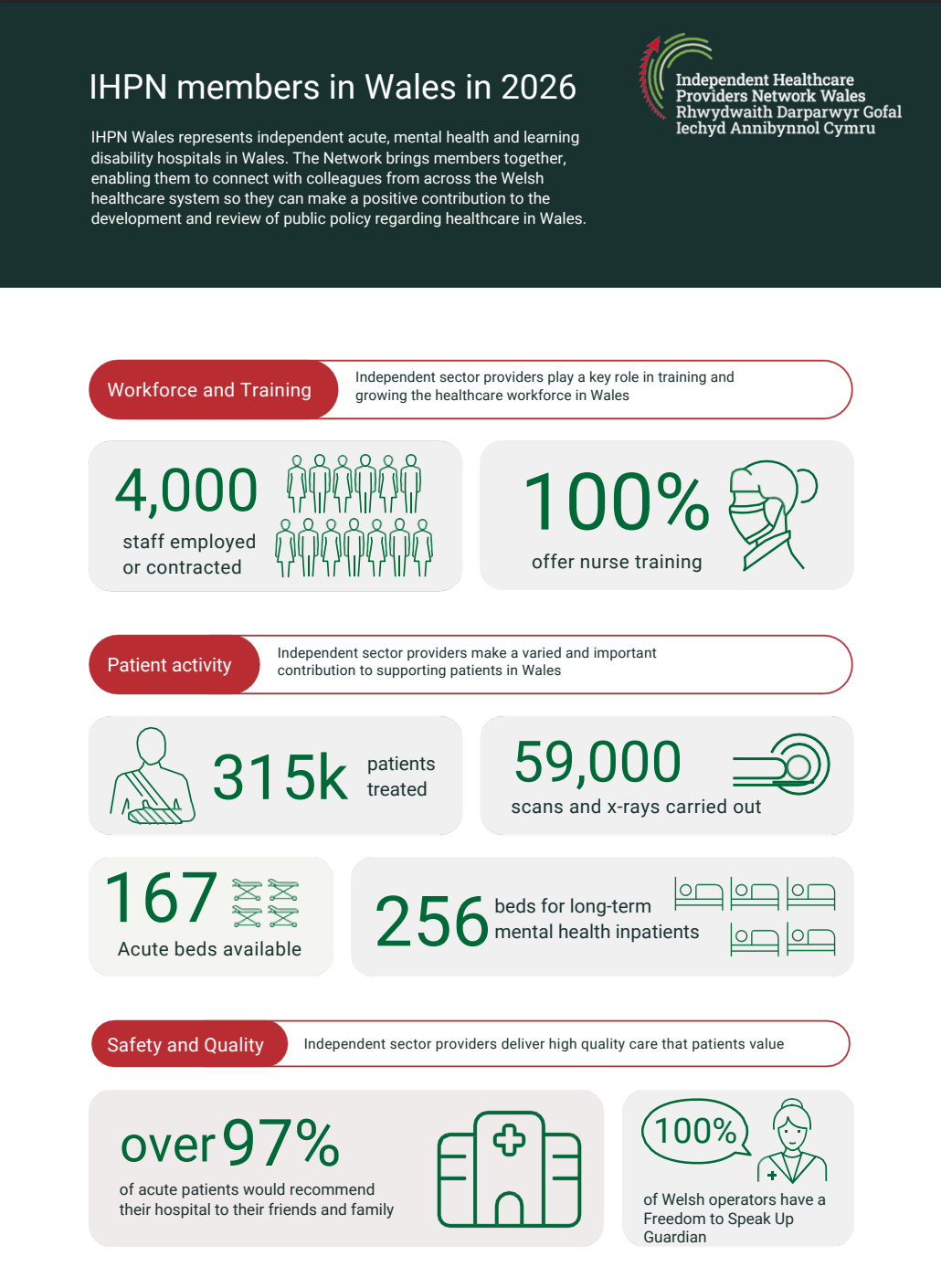
Find out more about IHPN Wales members here
Scotland
In Scotland, the SNP is expected to retain its dominant position, continuing a long-standing approach that combines strong public messaging around an NHS-first model with pragmatic use of additional capacity to address waiting lists. Scottish Labour’s positioning is notable for its explicit focus on using available capacity to improve access and performance, reflecting a more openly pragmatic tone than in previous cycles. Across parties, there is a shared emphasis on access, primary care, workforce and delayed discharge, with differences emerging more in framing than in underlying priorities.
Find out more about IHPN Scotland members here
What this means for wider UK politics
The read-across to English politics is significant. Although health is devolved, these elections will be interpreted as a broader signal of public sentiment, particularly in relation to NHS performance. Any perceived electoral pressure on Labour is likely to sharpen the focus on delivery, waiting times and patient experience. At the same time, it may reinforce caution around politically sensitive questions, particularly where debates risk being framed in terms of “privatisation”. Overall, the centre of political gravity continues to shift towards visible improvements in access and outcomes.
Across both nations, there is a clear convergence around the core challenges facing the health system, waiting lists, access, diagnostics, workforce and patient flow. The key differences lie in how these issues are articulated and the degree of openness to different delivery models. Parties on the left tend to emphasise NHS-led provision, prevention and system integration, while those on the right are more likely to foreground efficiency, choice and alternative approaches to delivery.
The overarching implication is that the political debate is becoming less about structural arguments and more about demonstrable performance, how quickly patients can access care, how effectively backlogs are reduced, and how sustainably the system can deliver improved outcomes.