
Zero-hours contract reforms must protect workers without compromising patient care
27/08/2026
IHPN supports the Government’s ambition to tackle exploitative employment practices and strengthen security and protections for workers. However, it is vital that reforms to zero-hours contracts recognise the particular realities of healthcare delivery and do not inadvertently make it harder for providers to maintain safe staffing levels, respond to changing patient demand and deliver NHS and private healthcare services.
That is the central message of IHPN’s response to the Government’s consultation on implementing the zero-hours contract provisions within the Employment Rights Act. The proposed reforms are designed to tackle “one-sided flexibility” by introducing rights to guaranteed hours, reasonable notice of shifts and compensation when shifts are cancelled at short notice.
As part of our response, we undertook a dedicated survey of IHPN members to understand how flexible staffing arrangements are used across independent healthcare and what the proposed changes could mean for providers, healthcare professionals, NHS services and, ultimately, patients. Representing providers that employ more than 150,000 people and deliver care to millions of NHS and private patients each year, we developed a response that reflects the experiences and concerns raised by members across the sector.
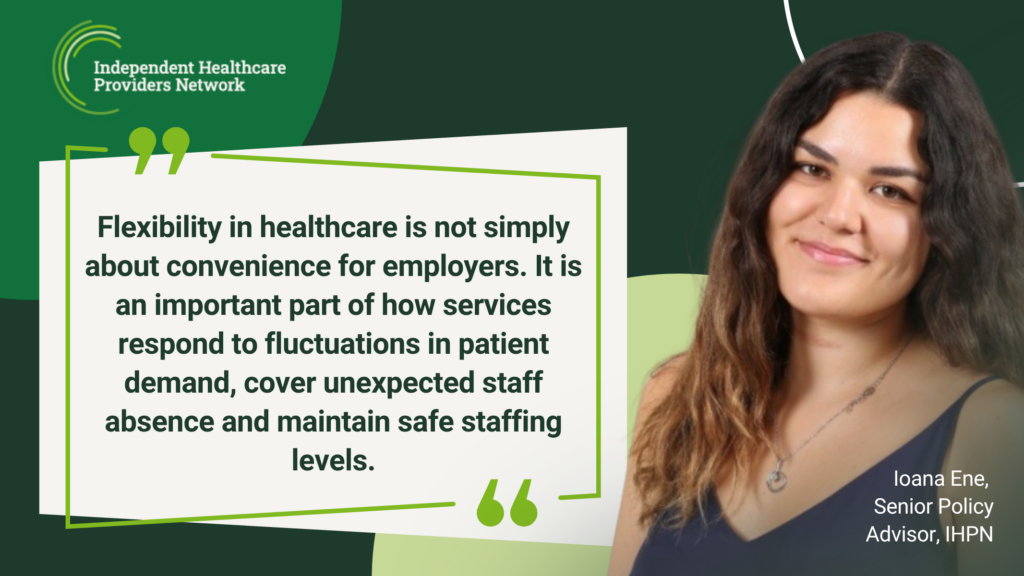
The findings show that flexibility in healthcare is not simply about convenience for employers. It is an important part of how services respond to fluctuations in patient demand, cover unexpected staff absence, provide additional capacity and maintain safe staffing levels. Flexible arrangements are also actively chosen by many healthcare professionals because they give them greater autonomy over when and how they work.
Similar concerns are shared across the wider healthcare system. NHS Employers have warned that the proposals could reduce workforce flexibility, increase administrative burdens and create significant additional costs for healthcare providers, while failing to fully account for the operational realities of delivering healthcare services.
Our submission therefore argues that the Government can achieve its objective of improving protections for workers while ensuring the new rules are sufficiently flexible to reflect the particular needs of healthcare and ensure the continued delivery of safe, responsive patient care.
The key messages from our response
1. Flexible staffing arrangements benefit both providers and workers
Flexible contracts are not simply a mechanism for employer flexibility. Healthcare professionals actively choose these arrangements because they support portfolio careers, caring responsibilities, study commitments, phased retirement, and the ability to combine work across multiple employers.
Flexible staffing arrangements therefore support workforce choice, while helping providers maintain safe and responsive services.
2. The reforms will increase administrative and operational burden
The proposed reforms will create significant additional bureaucracy. Implementing guaranteed hours, monitoring reference periods, tracking eligibility, administering compensation payments and maintaining compliance would require additional systems, processes and management oversight.
At a time when healthcare providers are being asked to improve productivity and maximise resources for frontline care, these additional administrative requirements risk diverting time and resource away from patient services.
3. The reforms do not fully reflect how healthcare services are delivered
Healthcare services are often influenced by changing patient demand, commissioning decisions, waiting-list initiatives and temporary service expansions. Workforce requirements can change quickly and are not always a reliable indicator of long-term demand. If reference periods and regularity requirements do not adequately reflect these realities, providers could be required to offer guaranteed hours based on temporary patterns of activity, creating ongoing employment liabilities after the underlying demand or commissioned activity has ended.
4. The reforms could create unintended consequences for healthcare delivery
There is concern that the increased costs and operational complexity associated with the reforms could make flexible staffing arrangements less viable. This could lead providers to reduce their reliance on bank workers and other flexible staffing models.
In practice, this could make it harder to respond quickly to changes in demand, cover unexpected absences, and maintain safe staffing levels. This risks increasing costs and limiting flexibility for both providers and healthcare professionals, with potential consequences for patient safety and service delivery.
Moreover, providers reducing the availability of these contracts could negatively impact the very workers the reforms are intended to support, by limiting opportunities for those who rely on flexible working arrangements to balance other professional and personal commitments.
5. Healthcare is one workforce
Finally, IHPN emphasised that healthcare is often delivered by a single workforce operating across both NHS and independent sector settings. Many clinicians work across multiple organisations and provide care to NHS and private patients alike. Independent providers also deliver a significant volume of NHS-funded services under contract. Any future modifications to the application of these reforms in healthcare should therefore apply consistently across both NHS and independent providers, reflecting the integrated nature of healthcare delivery in the UK.
What we are calling for
In our submission, IHPN calls for targeted exemptions and adjustments for healthcare providers and clinical workers in relation to guaranteed hours, shift notice requirements and short-notice cancellation payments.
As the Government moves towards implementation, it is essential that the new rules reflect the realities of delivering healthcare and avoid unintended consequences for patient care and service delivery across both the independent sector and the NHS. With the right safeguards in place, stronger protections for workers can be delivered without compromising the flexibility that helps keep healthcare services safe, responsive and accessible.