
The Missing Picture: Why NHS Data Underestimates the Independent Sector's Role in Diagnostics
06/08/2026
Last month’s publication of the Diagnostic Imaging Dataset (DID) by NHS England has given stats-watchers our latest insight into imaging activity across the NHS. The statistics reveal that in the last financial year the NHS delivered just over 50 million scans covering core modalities such as X-Ray, Ultrasound, Magnetic Resonance Imaging (MRI) and Computed Tomography (CT).
Independent sector (IS) providers form an important part of this landscape. The DID includes sixteen IS providers working across the country, including specialist diagnostics providers and private hospital groups collectively responsible for around 1.37m scans across the year.
However – what if this picture wasn’t complete, but only a partial image?
At the Independent Healthcare Providers Network, in addition those sixteen organisations above we represent another half dozen diagnostics providers, all of whom provide much needed capacity to the system. However, their contribution is hidden from the published data, as a result of the way in which the DID captures information including where IS providers have sub-contracted with NHS organisations. This means that their activity is reported as delivered by their host, even if the workforce, equipment and infrastructure are from independent providers.
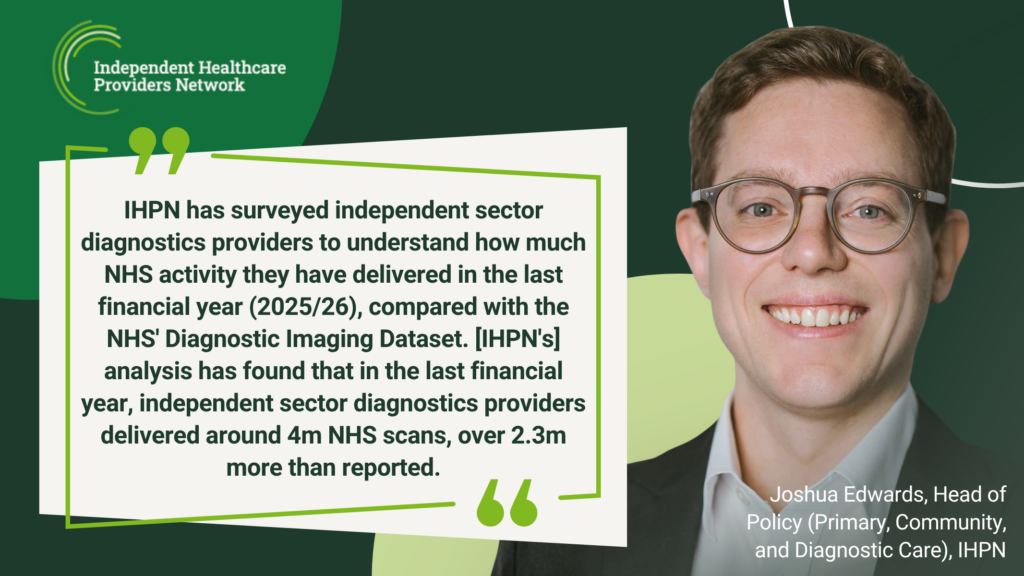
To help policy makers and patients understand the vital contribution these companies make to the NHS, IHPN has surveyed independent sector diagnostics providers to understand how much NHS activity they have delivered in the last financial year (2025/26), compared with the NHS’ Diagnostic Imaging Dataset.
Our analysis has found that in the last financial year (2025/26), independent sector diagnostics providers delivered around 4m NHS scans, over 2.3m more than reported.
This includes 8% of all CT scans, over 30% of MRI (that’s 1 in 3!), and just shy of half of all PET-CT scans across the country. In summary, about 1 in 4 of all diagnostic tests. Rather than being on the margins, these figures highlight the vital contribution the sector makes to diagnostic activity and demonstrate how independent sector providers are delivering for both patients and the NHS. This contribution is held to the same standards as those in the NHS, both in terms of quality and safety – with 94% of independent sector providers rated good or outstanding by the CQC – and financially, with diagnostics activity subject to the same tariff price as NHS partners.
IHPN recommend greater clarity and transparency within official datasets around reporting entities, so that policy makers and commissioners can make informed decisions based on clear, robust and transparent data.
We know, too, that there’s still opportunity to do more, as the number of people on a waiting list for diagnostic imaging remains stubbornly high. Over 1.9 million people are currently waiting for a diagnostic test, including 378,000 waiting for an MRI and 197,000 for a CT scan. The long-standing target for 99% of patients to wait no more than six weeks from referral to diagnosis has been missed since 2017, with 24% of patients waiting six weeks or more for a test overall, including 11% for a CT scan and 23% for an MRI.
This challenge is not going to solve itself. As part of its recent diagnostics market engagement, NHS England’s diagnostic demand and capacity modelling estimates that 35% of the capacity required between 2026/27 and 2028/29 needs to come from the independent sector. This equates to an estimated additional 2 million tests and could be achieved through either capacity or productivity initiatives, including digital infrastructure and tools, as well as patient engagement, ensuring patients are able to access diagnostic treatment where and when it suits them.
In light of recent policy initiatives centred around the increased productivity of Community Diagnostic Centres and the creation of the NHS Online Hospital, IS diagnostics providers are well placed to contribute to addressing these issues. The sector stands ready to engage with NHS England and NHS Trusts to add even more capacity and turn the current negative image into one that’s much more positive.