
The NHS Ten Year Plan at One: Progress, Promise and Priorities
06/07/2026
To mark one year since its publication, IHPN’s Head of Policy for Primary, Community, and Diagnostic care, Joshua Edwards, looks at the progress made so far in delivering the NHS’s 10 Year Plan for Health, and how the independent sector can help support the new Prime Minister and Secretary of State for Health turn its good words into good deeds.
With the World Cup in full swing, and the USA celebrating its 250th anniversary, it’s understandable that the NHS, too, wants to get in on the action. The invites have been sent out, the cake baked, balloons inflated and the presents wrapped. Everyone in the health sector has broken out the bunting and put up the banners to wish the 10 Year Plan for Health a very happy first birthday. But once the party’s over, the cake has been eaten and the presents tidied away, what can we say we’re celebrating?
As the trade association for independent healthcare providers, many of whom work hand in hand with the NHS to deliver patient care, there was a lot to welcome in the Plan’s ambitions. The aspiration to develop an NHS that makes best use of a plurality of providers; is increasingly focused on patient choice; and one that applies the same rules across the board to drive up high-quality access, treatment, and outcomes, remains something that we fully support in helping providers of all stripes to deliver the most value to the NHS and to patients.
As IHPN members will know, the NHS’ “three shifts” are championed in the plan – to move care out of hospitals; to drive digitisation and use of technology; and to emphasise prevention over treatment. These have unodubtedly retained their relevance and importance over the past year, despite a great deal of political upheaval and, within the NHS, a narrow focus on elective recovery and financial rigour – potentially at the cost of real progress against these ambitions.
Where we have seen some progress – albeit arguably not enough – is in the system architecture that will help to make these shifts happen, such as the reduction in the number of Integrated Care Boards and in approaches to market management, commissioning and contracting. Consultations around future tariffs, engagement around block contract deconstruction and thinking about how effective markets can be created, will all help to form the foundations for the plan’s next nine years.
Some green shoots are also present in the shift to digital delivery, especially in the creation of NHS Online, and the expansion of the NHS App. Both offer a real opportunity to put choice in the hands of patients, and ensure that all providers of NHS care are able to ‘plug in’ to the system and provide extra capacity which will be key to the success of these developing approaches.
We know from our forthcoming survey on the public’s awareness of their local healthcare options that there’s still much progress to be made before the NHS can offer Netflix-style choice, and it’s vital that these services respond accordingly and help patients to access treatment when and where they need it. This is why the Patient Choice Charter – committed to in the 10 Year Plan is so important. In our recent survey of GP attitudes to choice, just 10% said they believe patient choice actually works well in practice. We therefore want to see the Charter published in full, making choice visible, understandable and enforceable for every NHS patient. And all underpinned by requirements for commissioners to produce clear information for providers and patients to support patient choice.
Wider progress in implementing the 10 Year Plan, however, has not been distributed evenly. This is especially true of the drive to create a ‘Neighbourhood Health Service’, where concrete ambitions to expand provision and co-locate services has, at best, seen existing activity rebadged as something new. From our work with at-scale community and primary care providers earlier this year, many of them are keen to help realise the potential that shifting care to neighbourhoods can offer. As the NHS and government develop their thinking in this area and start to focus on the outcomes they want to see from the neighbourhood shift, the independent sector stands ready to share what works, including approaches to using data to identify high-risk patients; shifting services such as musculo-skeletal (MSK) support out of hospitals and into the community; reducing pressures on hospitals; and collaborating with NHS services to really drive integration around patient needs. Hearing Andy Burnham speak of his commitment to greater devolution for local areas under his ministry highlights just how this agenda can be turbo-charged, once systems are able to focus on delivery over disassembly.
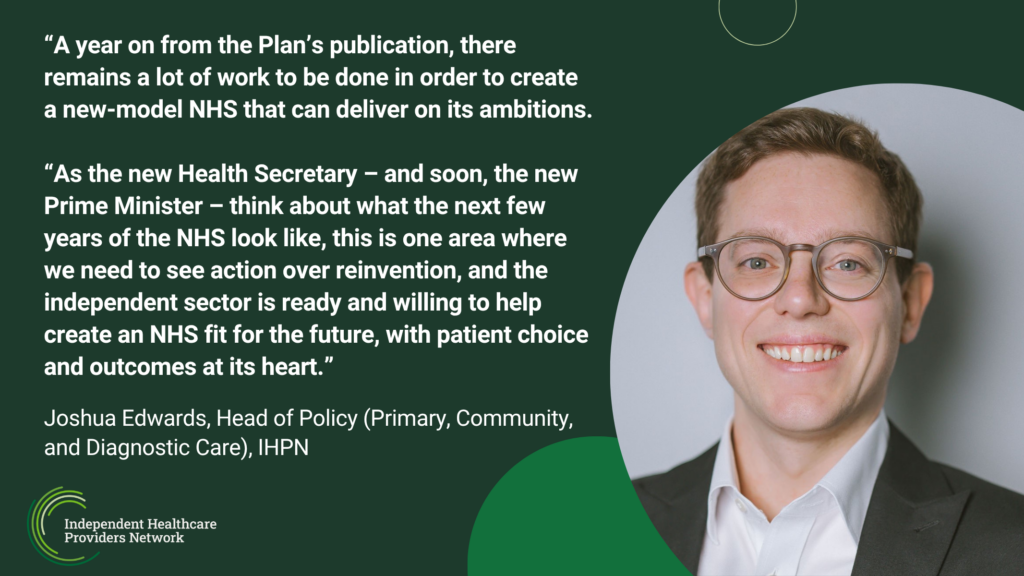
A year on from the Plan’s publication, there remains a lot of work to be done in order to create a new-model NHS that can deliver on its ambitions. As the new Health Secretary – and soon, the new Prime Minister – think about what the next few years of the NHS look like, this is one area where we need to see action over reinvention, and the independent sector is ready and willing to help create an NHS fit for the future, with patient choice and outcomes at its heart. The ambition is the right one, and I hope that by next July there will be even more to celebrate.