
Stop planning for capacity. Start using it.
29/09/2026
Across Britain, health systems are wrestling with the same problem: too many patients waiting too long for care. And across Britain, governments are responding with plans.
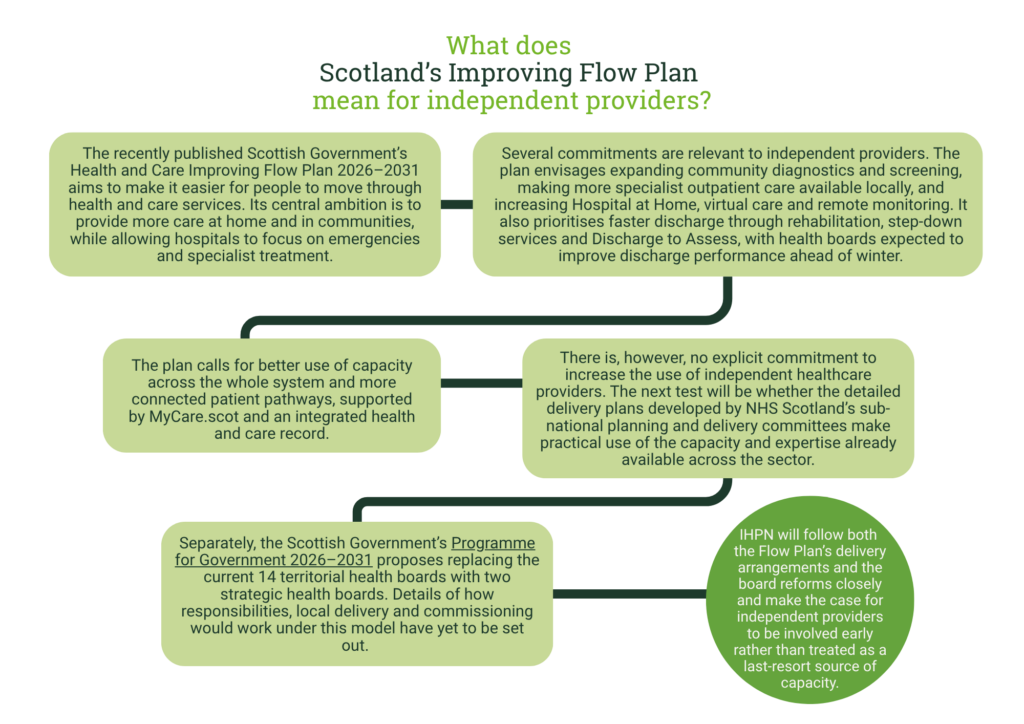
At the end of August, the Scottish Government published its new five-year Flow Plan, designed to create a more connected health and care system, shift more care into homes and communities, improve access and navigation, reduce delays and enable hospitals to focus on urgent and specialist care. There is plenty in the plan to welcome. But Scotland’s immediate challenge remains formidable.
Around 589,000 people, roughly one in nine people in Scotland are waiting for an outpatient appointment or treatment. Only 66% of new outpatient waits and 57% of inpatient and day-case waits are being completed within the 12-week standards. Progress has been made on the very longest waits and diagnostic backlogs, but the NHS remains a considerable distance from meeting its waiting-time guarantees. And the scale of the challenge is perhaps best illustrated by the Scottish Government’s new commitment that, by the end of 2031, no patient will wait more than 26 weeks for treatment.
Contrast that with England, where the government remains committed to restoring the NHS constitutional standard of 92% of patients beginning elective treatment within 18 weeks by March 2029. However, over 1.9 million people are currently waiting for a diagnostic test, including 378,000 waiting for an MRI and 197,000 for a CT scan. The long-standing target for 99% of patients to wait no more than six weeks from referral to diagnosis has been missed since 2017, with 24% of patients waiting six weeks or more for a test overall, including 11% for a CT scan and 23% for an MRI.
The two countries’ measures are not directly comparable – Scotland and England measure elective waiting times differently, but the contrast is nevertheless telling. At a time when patients across Britain are waiting too long for care, Scotland is setting itself until the end of the decade to reach a maximum waiting time that would still be eight weeks longer than England’s headline 18-week standard.
More importantly, Scotland’s existing standards are already considerably more ambitious: 95% of new outpatients should receive an appointment within 12 weeks and patients have a 12-week treatment-time guarantee for planned inpatient and day-case treatment. In other words, the ambition for the coming years reflects just how far current performance has drifted from where it is supposed to be. Scotland is far from alone.
In England, recent waiting-time performance has slipped back to levels not seen since last winter, making the ambition of getting 92% of patients treated within 18 weeks by March 2029 an increasingly formidable task.
Wales, meanwhile, has made substantial progress in tackling its longest waits, but it has not yet solved the underlying capacity problem. Around 700,000 pathways remain open, almost 100,000 have waited more than a year and diagnostic performance remains well short of government standards.
Earlier this month, the Welsh Government announced plans to eliminate two-year waits and return the overall waiting list to pre-pandemic levels before the end of the Senedd term. A clinically led Elective Care Task and Finish Group has also been established to develop a delivery plan for elective care hubs across Wales. Different countries. Different structures. Different plans. But very similar problems.
Scotland has its five-year Flow Plan. Wales is developing new plans for elective care. England is only a year into its 10 Year Health Plan, while a new Prime Minister and Health Secretary inevitably bring questions about what comes next and how the government’s wider five-year programme will interact with it. There is a danger that healthcare policy becomes a succession of plans about how, at some point in the future, we will create the capacity and new models of care needed to tackle waiting lists.
Meanwhile, some of that capacity is already there. Independent hospitals, diagnostic centres and other providers are treating NHS patients today. They have infrastructure, equipment, clinical teams and, crucially, the flexibility to increase activity in areas where NHS capacity is constrained. So why aren’t we pulling that lever harder?
This isn’t an argument against reform. Moving more care out of hospitals, joining up services, improving patient pathways and putting greater emphasis on prevention are all important. Indeed, independent providers can play a much bigger part in those ambitions too. But long-term transformation cannot become a reason to leave available capacity unused in the short term. Scotland’s Flow Plan, for example, contains no clear commitment to increase NHS-funded activity through independent hospitals or diagnostic providers, nor the commissioning and procurement mechanisms needed to make that happen at scale. That feels like a significant missed opportunity.
In England, the 10 Year Health Plan recognises a role for the independent sector, but recognition on paper does not automatically translate into patients being treated. Too often, capacity exists but local commissioning, contracting or pathway arrangements prevent it from being fully used. And in Wales, the creation of more elective hubs may form part of the solution. But again, the question should not simply be where can we create more capacity? It should also be where does capacity already exist that we could use now? Because patients aren’t waiting for a strategy. They are waiting for a scan, an outpatient appointment, an ADHD assessment or an operation.
There is a wider prize here too. Governments across Britain rightly want health services to move from sickness to prevention, from hospital to community and from fragmented services to more joined-up care. But making that transition is considerably harder when services are consumed by today’s backlog. Using additional independent-sector capacity to tackle immediate demand can help create the headroom needed to make longer-term reform possible. So this isn’t a choice between transformation and capacity. We need both.
Across England, Scotland and Wales, governments have set ambitious goals for reducing waiting times and redesigning care. The independent sector cannot solve every problem facing our health services, and nobody credible is suggesting that it can. But it can do more. The hospitals are there. The diagnostic capacity is there. The workforce and expertise are there. And independent providers are already delivering NHS-funded care across the country. So alongside every new five-year plan, ten-year strategy, taskforce and delivery programme, governments should ask a much simpler question: What capacity is available right now, and what is stopping us from using it?
Because patients need capacity today, not just plans for capacity tomorrow. Sometimes the answer isn’t another plan. It’s pulling the lever that’s already there.