
Driving consistency in ADHD, autism and mental health care: What does Professor Fonagy’s review propose?
12/10/2026
Last December, Rt Hon Wes Streeting MP, then Health Secretary, commissioned an Independent Review into mental health conditions, ADHD and Autism, appointing Professor Peter Fonagy as Chair to investigate the changing prevalence of conditions, the impact of current clinical practice, the role of medicalisation and medication and the wider social and cultural factors influencing people to come forward for support.
The publication last Friday of the Review’s final report provides a nuanced perspective on these questions, meriting a careful reading of its 600 pages (and 200+ page annex), rather than a skim of the headlines.
It represents an important milestone for the Government’s wider reform agenda spanning health, education and welfare as a consequence. Many of the Review’s recommendations have already been accepted by the Government and its findings will influence the tone and direction of the forthcoming Mental Health Strategy, due by the end of this year.
Prevalence & System Performance
The Review concludes there has been an increase in distress, particularly among younger people, with a growth in prevalence of anxiety, depression, self-harm and eating disorders. A more complex picture emerges in ADHD and autism, with population prevalence more stable in some datasets, whilst referrals, self-identification and recorded diagnoses have risen more sharply. The Review could not “conclude that overdiagnosis is occurring at scale”, however, “particularly given the gaps in population prevalence data and data reporting”, but that “the rapid increases in administrative prevalence and demand for diagnostic assessments…are creating the conditions for increasing risk of misdiagnoses”.
As a result, the Review recognises growing complexity as well as unmet need; the need to provide support earlier, but without diminishing the importance of specialist assessments and diagnosis; the need to strengthen clinical quality and oversight across providers; and a need to develop more integrated pathways of care that are more focused on outcomes, rather than an emphasis on activity alone.
The Review reflects that current models of access are not working consistently across the country. “Fragmented commissioning, can create gaps in oversight”, it states. Indeed, patients can experience radically different pathways depending on where they live, differentiation in the model of care, post-diagnostic support and acceptance of shared care.
There is a significant postcode lottery across ADHD and Autism services in particular, driven by variable commissioning behaviours, including the introduction of ‘minimum waiting times’ across a number of ICBs of up to two years.
Raising Standards and Oversight
But the Review is also candid that publicly funded ADHD and Autism assessments, many of which are delivered for NHS patients by the independent sector, have grown faster than the arrangements required to assure it. Amidst the growth in patient demand – and in a diversification of the provider landscape – it is clear there have been greater challenges for commissioners in ensuring consistent standards and oversight in the absence of clear national standards and strategy.
Many independent sector providers, however, deliver “excellent care” as Professor Fonagy stated on the Today Programme, with many providers developing expertise in delivering accessible, highly efficient and high-quality pathways, built upon the development of a specialist clinical workforce, digital infrastructure and service models that have proven sufficiently flexible to respond to demand at scale.
As such, the Review’s findings “support the need for common, transparent quality standards across all providers, rather than assumptions about either sector [NHS or independent]”.
IHPN welcome the Review’s call for stronger reporting and oversight. Recommendation 5 proposes that all diagnostic assessments for ADHD and Autism become a Care Quality Commission (CQC) regulated activity, with consistent quality standards and reporting. We are pleased to see that CQC have already announced they will take this work forward.
Recommendation 8 calls for NICE guidelines to be updated, alongside improved data collection from providers and analysis. These are all recommendations that were made in IHPN’s recent Building Better Neurodevelopmental Services report.
The Review identifies inconsistency – or an absence of routine national data collection – on severity, functional impairment and outcomes. It recommends a common minimum dataset; outcomes-based data; information following the patient between providers; reporting of functioning, participation and outcomes; data broken down to expose inequalities; and all consistently reported, regardless of provider type.
Building on this, there are a number of recommendations which encourage improved digital assessment and support. An ADHD Passport, available via the NHS App, is proposed “so that established medication can continue when people move location rather than requiring reassessment”.
One recommendation requiring careful consideration is a proposed “clinically led review of ADHD and autism waiting lists”. Identifying each person’s main presenting concern, ensuring they are on the most appropriate pathway and offering support while waiting, are welcome objectives – and the Review is explicit that the purpose should not be to remove people from waiting lists without appropriate support. These safeguards are essential given patients the Review says, “continue to face barriers to timely treatment, increasing the risk that difficulties escalate and become more severe”.
Improving Access and Addressing ‘Unacceptable Waits’
These risks are real: there are more than a million people in England waiting for an NHS ADHD or Autism assessment today and many have waited considerable lengths of time for support. IHPN’s analysis is that in almost 2/3 of ICBs, half of ADHD referrals had been open for more than a year, the organisation said. In seven ICBs across England, 40 per cent of patients have been waiting at least two years. The Review’s own evidence shows that the proportion of people whose difficulties worsen while waiting rises from around one in four to more than seven in ten as waits stretch beyond six months.
Ultimately, the Review asks government, the NHS and providers to build a fairer system around need, quality and participation and notes whilst the “NHS remains central to clinical care…its role increasingly includes convening and coordinating support with partners”. A successful, future national strategy must therefore harness the strengths of all regulated, high-quality provider capacity to maximise their capability and capacity.
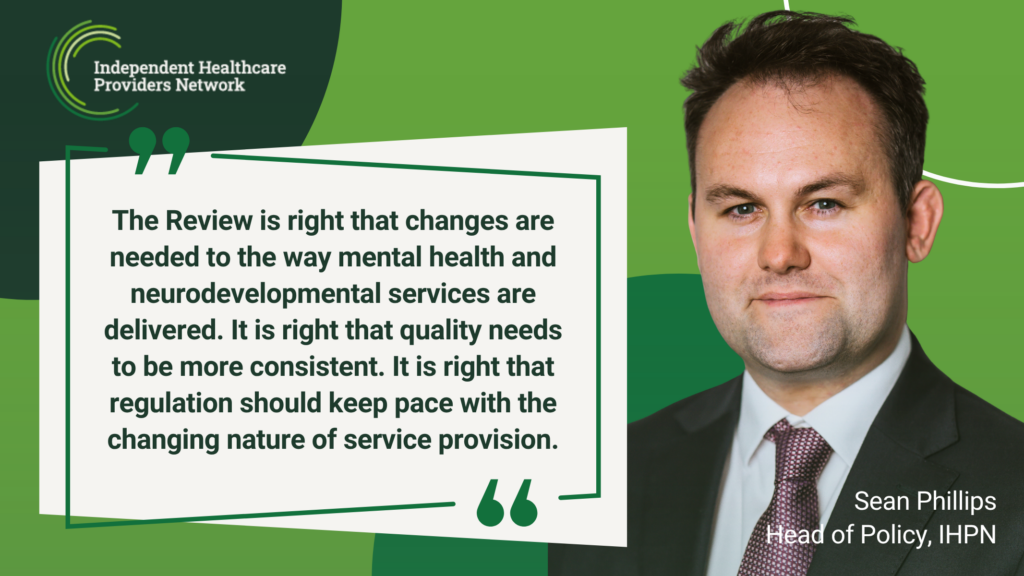
The Review is right that changes are needed to the way mental health and neurodevelopmental services are delivered. It is right that quality needs to be more consistent. It is right that regulation should keep pace with the changing nature of service provision
Ultimately, reform should be driven by a single question: how do we ensure that people receive the right support, from a high-quality provider, in a time-appropriate manner– and that we enable patients to exercise their right to choose in doing so?
Our members are ready to play their full part in delivering upon these objectives – and are a key part of the solution in delivering the ‘new model of care and radical reform’ that Professor Fonagy and his Co-Chairs are envisaging.