
Choice is the Missing Ingredient in the NHS’s Community Care “Soup”
15/10/2026
The NHS has spent years talking about a “left shift” of care. Moving services out of hospitals and into communities makes perfect sense. It’s better for patients, better for outcomes, and better for the sustainability of the health service.
The problem? Talking about the shift is much easier than making it happen.
Just 12 months after the Government renewed its commitment to delivering more care closer to home, the reality is proving difficult. Financial pressures, organisational reform, shifting political priorities, and relentless operational demands have all conspired to slow progress.
But that doesn’t mean we should abandon the ambition. In fact, the growing pressures on hospitals make it more important than ever – summer pressures have morphed into winter pressures without a break. The question is not whether we need more community care. It’s how we create the conditions for it to flourish.
Community care is not a side issue
Community services are sometimes treated as the NHS’s forgotten service. Yet they support over a million people waiting for care, from children needing speech and language therapy to adults requiring musculoskeletal (MSK) support, rehabilitation, and long-term condition management. These aren’t optional services.
For a child waiting months for speech therapy, every delayed appointment can affect educational attainment and future opportunities. For someone living with chronic pain, waiting for MSK treatment can mean time off work, worsening health and a growing risk of economic inactivity. The work by Keep Britain Working has made that abundantly clear.
Indeed, MSK conditions remain one of the biggest drivers of people leaving the workforce. Yet despite demand rising sharply, community MSK services are actually performing well against waiting time standards.
The lesson is simple: community services can deliver. They just need the tools to do more.
The NHS doesn’t have a capacity problem
Today, around 800 organisations deliver community health services in England. Nearly half are non-NHS providers, including independent and voluntary sector organisations. Many independent providers operate at scale, bringing innovation, specialist expertise and the ability to grow capacity quickly when demand rises. And yet capability remains under-utilised.
Why? Because unlike elective care, community services largely lack the mechanisms that allow patients, commissioners and providers to respond dynamically to demand.
In elective care, if one provider has long waits, patients can choose another. Capacity follows demand. In community care, patients are often locked into local pathways, regardless of waiting times or available alternatives. The result is predictable. Some services struggle with overwhelming demand while capacity elsewhere remains untapped.
Follow the patient. The rest will follow.
If the Government is serious about shifting care into the community, it needs to introduce the financial architecture that makes growth possible. That starts with two straightforward principles.
First, establish a clear national price for a standardised minimum offer for community activity. Providers should know what they will be paid for delivering care. Commissioners should know what they are buying. The current patchwork of local arrangements creates uncertainty, slows investment and makes scaling services unnecessarily difficult.
Second, allow money to follow the patient and move away from the block! When a patient chooses a provider, funding should move with them. This is not a radical concept. It is already embedded across much of elective care and has helped drive reductions in waiting times through greater competition, transparency and patient choice.
Community services deserve the same approach.
An activity-based system creates incentives to treat more patients, reduce waits and improve access. It rewards providers who deliver high-quality care efficiently and gives patients a greater say over where they are treated. Most importantly, it directs resources to where demand actually exists.
Choice is not a threat. It’s an accelerator.
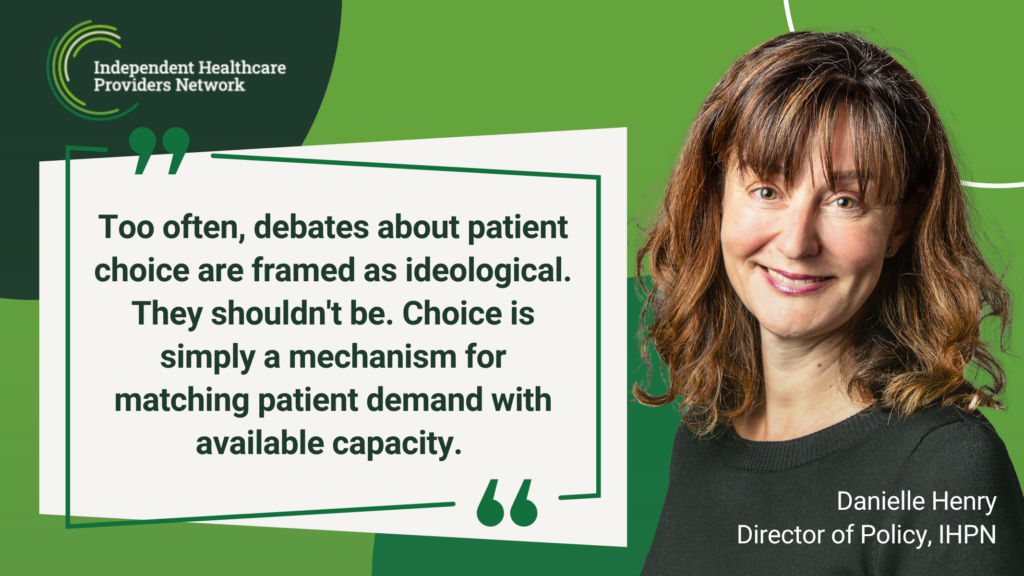
Too often, debates about patient choice are framed as ideological. They shouldn’t be. Choice is simply a mechanism for matching patient demand with available capacity. At a time when NHS leaders are facing difficult questions about meeting waiting time commitments, it is difficult to argue against using every available resource to improve access.
Expanding choice would unlock capacity across NHS, independent and voluntary sector providers. It would create faster routes into care. And it would help make the long-promised shift from hospital to community a practical reality rather than a strategic aspiration.
It is time to move beyond the rhetoric. The NHS knows where it wants to go. The policy direction is clear: care closer to home; prevention over treatment; community over hospital.
But aspirations alone won’t deliver transformation. If we want more care in the community, we need a system that actively supports it: clear pricing, activity-based funding, and genuine patient choice.
The recipe is simple: set the price; define the service specs; expand choice; let money follow the patient. Only then will the NHS have the foundations it needs to turn its community care ambitions into reality.